
Should Your Small Business Use an AI Receptionist?
Short answer: probably not. Slightly longer answer: it depends entirely on whether we're talking about voice or chat, and most people selling these don't make that distinction.
We'll build one if you want it. We just won't tell you it's a good idea.
What happened when we tested one
We set up an AI voice agent for a client. Small local service business, the usual problem: calls coming in while nobody's free to pick up.
On paper, it should have worked. The agent answered instantly, every time, and it never got tired or missed a call.
Then we looked at what actually happened on those calls.
Roughly half the people who rang hung up the moment they realize
d they were talking to a robot. Not after a bad experience. Not because the agent gave them wrong information. They heard it, understood what it was, and ended the call.
That's not a tuning problem you fix with a better script or a more natural voice. That's people telling you something.
Why voice breaks when chat doesn't
We have no issue with AI chat. We build it, we use it, and it works.
The difference is expectation.
When someone types into a chat box on your website, they're not expecting a person. Chat widgets have been automated for years. The interaction is low stakes, they can close the tab whenever they like, and nobody feels misled.
When someone picks up the phone to call a small local business, they expect a person. That's the whole reason they chose to call rather than fill in a form. They've got a question that needs a human answer, or they want to get a feel for the place before they book.
Getting a robot instead isn't neutral. It's a small betrayal of what they expected, and a meaningful number of them will simply leave.
Big companies get away with it. You don't.
Nobody is surprised when a bank or an airline puts an automated system in front of them. The expectation is already low. There's no relationship to damage.
A local clinic, studio or trade is different. The reason people choose you over the bigger option is that you're a real business run by real people. An AI receptionist quietly undercuts that, and it does it in the first five seconds of contact.
It's the same instinct as AI slop
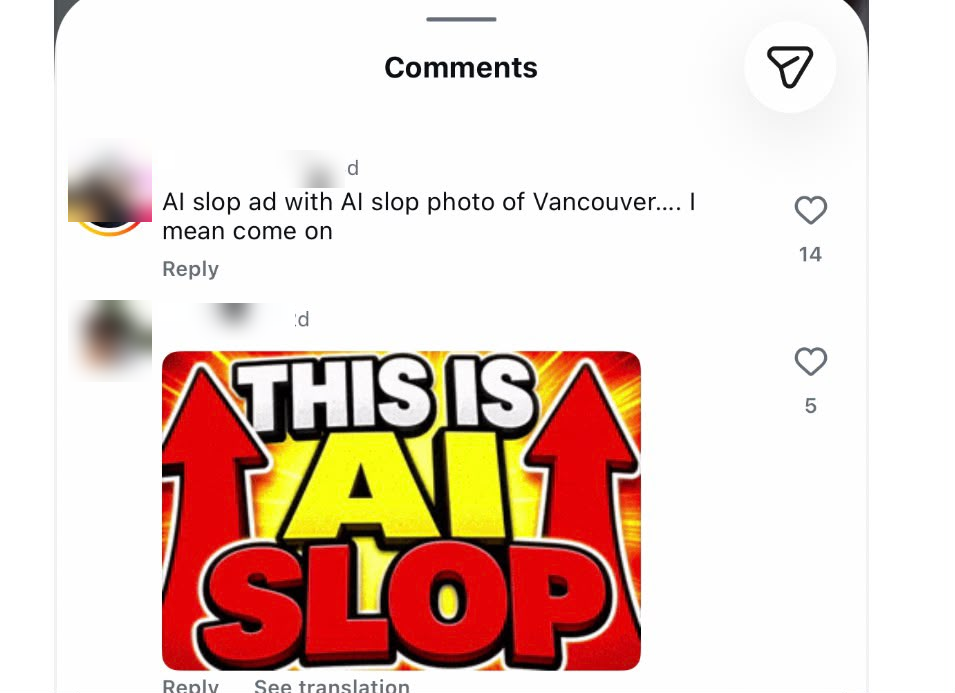
You've probably seen the comments under obviously AI-generated ads. People don't just scroll past. They stop, point it out, and think less of the business.
It isn't really about the technology. It's about what it signals. When a small business uses something that feels synthetic, people read it as not bothering, and that reads across to how you'd treat them as a customer.
An AI voice agent is the audio version of the same problem. Most people can't articulate what's wrong with it. They just don't like it, and they go elsewhere.
What to do instead
The problem an AI receptionist is sold as solving is real. You can't answer the phone mid-treatment, mid-class or halfway up a ladder, and every missed call is money walking.
Here's what we build instead.
Missed call text-back
A call comes in, nobody answers, and a text goes out within seconds. Something like: sorry we missed you, we're with a client, what can we help with?
This is the single highest-value thing most local businesses can set up, and it's cheaper than an AI agent.
What it does is convert a phone call into a text thread. A call demands you stop everything and answer right now. A text doesn't. You can reply between appointments, at lunch, or on the drive home, and the person on the other end is fine with that.
A person answers the thread
Not an AI. This is where the distinction holds.
People will happily text with a business, and crucially, they don't expect an instant reply to a text the way they do to a ringing phone. You've got a couple of hours of grace that you simply don't have on a call.
That gap is where the whole thing works.
Chat on the website
This is where AI genuinely earns its place. Nobody expects a person behind a chat widget, the questions are usually simple and repetitive, and it handles them perfectly well at two in the morning when you're asleep.
Sometimes the honest answer is a person
If you're missing half your calls, that might not be a software problem. It might be a staffing problem.
A virtual assistant is still a better option than an AI voice agent for most local businesses. It costs more than software and less than a hire, and the person calling you gets what they expected when they picked up the phone.
Nobody selling AI receptionists is going to tell you that.

If you still want one, we'll build it
This isn't a hard rule and we're not precious about it.
We'll show you the numbers, explain what we've seen, and tell you honestly that we don't recommend it for a small local business. If you've heard us out and you still want to try it, we'll set it up properly.
It's your business. Our job is to make sure you're deciding with the full picture, not to decide for you.
There are also businesses where it genuinely fits. High call volume, repetitive enquiries, a customer base that doesn't expect a personal relationship. If that's you, the maths changes.
Most local service businesses aren't that.
The line we draw
AI for the repetition. People for the connection.
That's the whole rule, and it holds up almost everywhere. Use automation for the things that are the same every time, that nobody enjoys, and that don't require anyone to feel anything. Follow-up sequences, reminders, routine questions, the admin that eats your evenings.
Keep people for the parts where the relationship is being formed. The first phone call is almost always one of those.
Want to talk it through?
If you're losing calls and trying to work out what to do about it, we're happy to go through the options with you. Thirty minutes, no pitch, and you'll leave knowing what we'd set up first.